

Si tu profesor te ha dicho que shout, yell, scream y cry significan “gritar”, tiene razón… pero solo a medias. Cada uno se usa en una situación distinta y mezclarlos suena raro a un nativo.
En esta guía te explico cómo decir “gritar” en inglés sin equivocarte: la diferencia entre scream y shout (los dos más confundidos), más los matices de yell y cry, las construcciones más comunes con cada uno, las expresiones idiomáticas que tienes que reconocer, y los errores que SOLO comete un hispano (los he visto miles de veces dando clases TEFL). Al final te dejo un test rápido para que confirmes que lo dominas.
La diferencia entre scream y shout es de matiz: shout es un grito de volumen (alzar la voz para llamar la atención o sobre ruido), mientras que scream es un grito agudo y descontrolado, asociado a miedo, pánico o emoción extrema. Yell suma carga emocional negativa por defecto y cry hoy se usa para “llorar”, no para “gritar”.
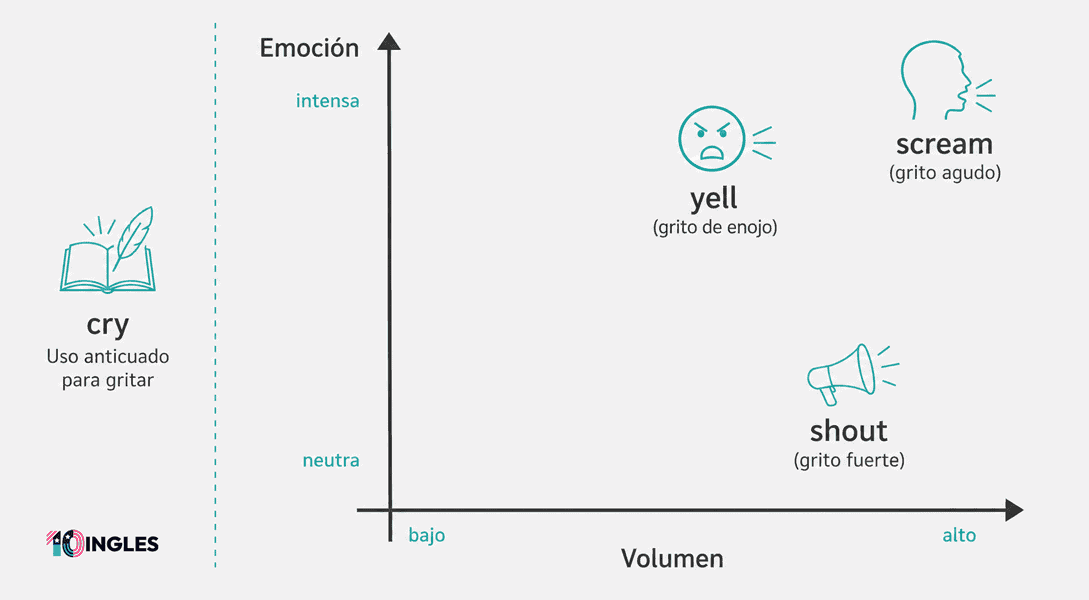
- Resumen rápido: shout vs yell vs scream
- Shout — el grito de volumen
- Yell — el grito emocional
- Scream — el grito agudo
- Cry — el caso aparte
- Otras palabras útiles: holler, screech, squeal
- Errores típicos del hispanohablante
- Pon a prueba lo aprendido: 10 Ejercicios
- Cómo usar shout, yell y scream sin equivocarte
Resumen rápido: shout vs yell vs scream
Antes de entrar verbo por verbo, esta tabla te da el panorama completo de un vistazo:
| Verbo | Pronunciación | Matiz central | Cuándo usarlo |
|---|---|---|---|
| shout | /ʃaʊt/ | volumen | Atraer atención, hablar sobre ruido, regañar |
| yell | /jel/ | emoción negativa (por defecto) | Enojo, dolor, frustración |
| scream | /skriːm/ | grito agudo y descontrolado | Miedo, pánico, alarido, emoción intensa |
| cry | /kraɪ/ | llorar (uso moderno) / gritar (anticuado) | Hoy se usa para “llorar”; para “gritar” es anticuado |
Ahora vamos uno por uno.
Shout — el grito de volumen
Shout es el verbo más general y neutro para decir “gritar” en inglés. Su matiz central es el volumen, no la emoción. Conjugación: shout — shouted — shouted.
Cuándo usarlo
Para entender la diferencia entre scream y shout, empieza por shout. Lo usas cuando:
- El entorno es ruidoso y necesitas que te escuchen
- Quieres llamar la atención de alguien que está lejos
- Estás regañando a alguien (sí entra emoción, pero el foco sigue siendo subir el volumen)
- Estás enojado, asustado o emocionado y alzas la voz
Ejemplos:
- “There is too much noise — I can’t hear anything!” she shouted. — ¡Hay demasiado ruido, no escucho nada! — gritó ella.
- “See you later!” he shouted from the balcony. — ¡Nos vemos luego! — gritó él desde el balcón.
- I could hear the football fans shouting at the stadium. — Podía oír a los fanáticos gritando en el estadio.
- I can hear you, so please don’t shout. — Te escucho, así que por favor no grites.
- William shouted as loud as he could. — William gritó tan fuerte como pudo.
- When we finished our performance, a shout of “Bravo!” greeted us. — Cuando terminamos la actuación, nos recibió un grito de “¡Bravo!”.
Construcciones con preposiciones: shout to / at / for
Esta es la distinción que más confunde al hispano. Las tres preposiciones cambian el sentido:
shout to + persona → gritarle a alguien para que te escuche (sin enojo, llamar la atención):
- Peter shouted to Louise that he had left the keys on the fridge. — Peter le gritó a Louise que había dejado las llaves sobre el refrigerador.
- The mother shouted to the boy to come home immediately. — La madre le gritó al niño que regresara a casa de inmediato.
shout at + persona → gritarle a alguien con enojo, regañar:
- My teacher is always shouting at me. — Mi profesor siempre me está gritando.
- The mother shouted at her daughter because she was running with a pen. — La madre regañó a su hija porque corría con una pluma.
- She was shouting at her brother all evening. — Ella estuvo gritándole a su hermano toda la tarde.
- If the children made a great noise, she shouted at them. — Si los niños hacían mucho ruido, ella les gritaba.
shout for + algo/alguien → gritar pidiendo algo:
- He shouted for help, but no-one was passing by. — Él gritó pidiendo ayuda, pero nadie pasaba.
- We shouted for Harry to hurry up. — Le gritamos a Harry para que se apurara.
Expresiones útiles con shout
| Expresión | Significado | Ejemplo |
|---|---|---|
| a shouting match | pelea fuerte y prolongada con gritos | A small misunderstanding turned into a shouting match. |
| within shouting distance | a una distancia corta | You can still stop him — he is within shouting distance. |
| nothing to shout about | nada especial | I’ve seen that performance, but it’s nothing to shout about. |
| shout from the rooftops | querer contarle a todo el mundo | When I passed the exam I wanted to shout my results from the rooftops. |
| shout oneself hoarse | gritar hasta quedarse ronco | I was shouting myself hoarse when I passed the exam. |
| shout at the top of your voice | gritar a todo pulmón | He was shouting her name at the top of his voice. |
| shout (someone) down | acallar a alguien gritando más fuerte | He tried to tell the truth, but I shouted him down. |
| shout out (slang) | expresión de gratitud o reconocimiento | Eminem gave shout outs to many rappers on his albums. |
| shout for joy | gritar de alegría | The kids shouted for joy when they saw the puppy. |
| shout insults / abuse | gritar insultos | There is no reason for shouting abuse. |
Yell — el grito emocional
Hasta aquí shout. Pasemos al segundo verbo más confundido: yell. Aquí entra otra confusión típica: la diferencia entre yell y shout. Es similar a shout, pero con un matiz emocional mucho más cargado. Conjugación: yell — yelled — yelled.
Cuándo usarlo
Yell casi siempre va asociado a:
- Enojo (el uso más común y por defecto)
- Dolor físico
- Emoción intensa (un susto, una pelea, una situación límite)
Como el enojo es su gatillo principal, vale la pena cruzarlo con idioms para expresar enojo en inglés cuando quieras ampliar el repertorio.
Ojo con este punto: si dices solo “she yelled” sin contexto, el oyente automáticamente asume que está enojada. Ese es el sesgo por defecto de la palabra.
Ejemplos:
- “Nonsense!” she yelled. — ¡Tonterías! — gritó ella.
- My neighbours were yelling at each other all week. — Mis vecinos estuvieron gritándose toda la semana.
- I accidentally stepped on his foot and he started yelling at me just in front of everybody. — Sin querer le pisé el pie y empezó a gritarme delante de todos.
- Stop yelling and turn the TV down. — Deja de gritar y baja el volumen de la televisión.
- Sara has just yelled at me for nothing. — Sara me acaba de gritar por nada.
- “Take your hands off my child!” she yelled. — ¡Quita tus manos de mi hijo! — gritó ella.
yell at = “regañar a alguien gritando”:
- My mom yelled at me because I came home late. — Mi mamá me regañó porque llegué tarde.
- His boss always yells at him for dressing poorly. — Su jefe siempre lo regaña por vestir mal.
Cuidado: yell no es “vítores”
Atención aquí, porque este error lo veo cada semana. En español a veces castellanizamos “yell” como sinónimo de “echar porras / dar ánimos / dar vítores”. En inglés ESO NO EXISTE. Yell siempre tiene carga negativa o emocional fuerte.
Si quieres decir “echar porras” o “animar” en inglés, usa:
- cheer for → animar a alguien
- root for → apoyar (especialmente en deportes)
Compara:
- ❌ She yells at the TV during baseball games. → Suena a que está enojada con la TV.
- ✅ She cheers for her team during baseball games. → Está animando a su equipo.
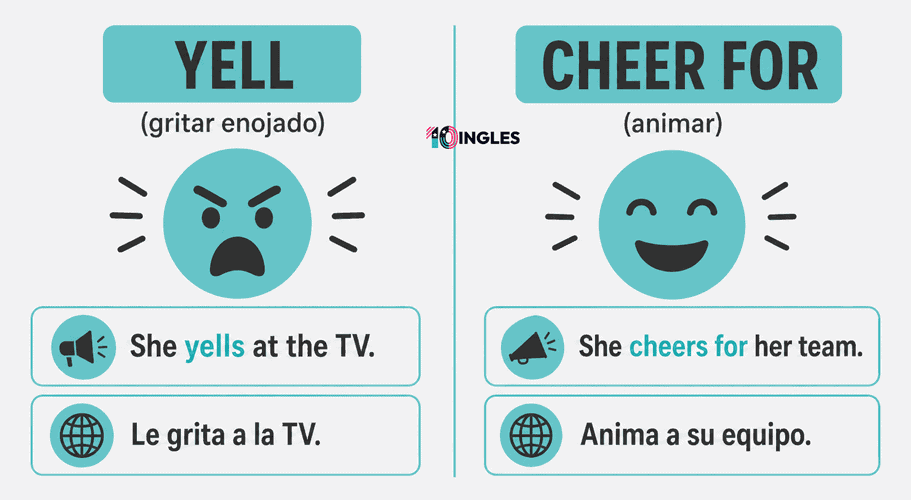
Sí puedes usar yell para gritos de emoción positiva en contexto deportivo, pero solo si el contexto deja clarísimo que es emoción positiva:
- The team yelled “Let’s go!” and ran onto the field. — El equipo gritó “¡Vamos!” y salió al campo.
- He yelled when one of his team members scored. — Él gritó cuando uno de sus compañeros anotó.
- He’s far away, so if you want to cheer for him, you have to yell. — Está lejos, así que si quieres animarlo, tienes que gritar fuerte.
Expresiones útiles con yell
| Expresión | Significado | Ejemplo |
|---|---|---|
| a yell of surprise/triumph | grito de sorpresa/triunfo | Everyone gave a yell of surprise when I entered the room. |
| yell silently | maldecir mentalmente | She yelled silently when her boss noticed her mistake. |
| yell one’s head off / yell one’s guts out | desgañitarse, gritar muy fuerte | Rick was furious and yelled his guts out. |
| let out a yell | lanzar un grito | I let out a yell, but nobody heard me. |
| yell back and forth | gritarse unos a otros | They were yelling back and forth across the street. |
| give (someone) a yell (informal) | avisar a alguien | Give me a yell when you’re finished. |
| yell uncle | rendirse, pedir clemencia | He finally yelled uncle and apologized. |
Scream — el grito agudo
Vamos al tercero. Scream es el grito más agudo y descontrolado de los cuatro. Conjugación: scream — screamed — screamed.
Cuándo usarlo
Lo usas cuando hay emoción intensa fuera de control:
- Miedo / terror
- Pánico
- Dolor agudo
- Furia extrema
- Emoción positiva muy intensa (susto positivo, sorpresa fuerte, fan enloquecido)
Es el grito que suelta alguien cuando ve un fantasma, se quema, o gana la lotería. No es la voz subida — es el alarido.
Por cierto: el famoso cuadro de Munch “El Grito” se llama The Scream en inglés. Te servirá para memorizar el matiz.
Ejemplos:
- I could hear the people screaming. — Podía escuchar a la gente gritando.
- She screamed when she saw the ghost. — Ella gritó cuando vio el fantasma.
- She screamed in terror when she saw a rat in the kitchen. — Ella gritó de terror cuando vio una rata en la cocina.
- The knife hit his foot and he screamed in pain. — El cuchillo le golpeó el pie y gritó de dolor.
- He screamed with excitement. — Él gritó de emoción.
- Jane was screaming with excitement when her boyfriend proposed to her. — Jane gritaba de emoción cuando su novio le propuso matrimonio.
- He was screaming with pain and begging for anesthetic. — Gritaba de dolor y suplicaba un analgésico.
- I heard them screaming for help, but there was nothing I could do. — Los oí gritar pidiendo ayuda, pero no había nada que pudiera hacer.
Si quieres explorar más matices del verbo, puedes consultar la entrada de scream en el Cambridge Dictionary, que incluye thesaurus y ejemplos de uso reales.
Construcciones con preposiciones: para indicar la emoción del grito, usa in o with:
- scream in pain / terror / horror → emociones negativas
- scream with excitement / joy → emociones positivas (with también funciona con negativas)
Uso figurado: scream también significa “llamar la atención de forma chillona” (titulares, ropa, anuncios):
- “The new prime minister has been elected*,**” screamed the headlines.* — gritaban los titulares.
- Her short skirt screamed vulgarity. — Su falda corta gritaba vulgaridad.
Scream como slang (“una persona divertida”)
Aquí viene el dato curioso. Scream como sustantivo en slang significa todo lo contrario a lo que esperarías: una persona o cosa muy divertida, que te hace reír sin parar.
- He is a real scream. — Es muy divertido.
- That movie was a scream! — ¡Esa película fue divertidísima!
- I love your cousin. She’s a scream to hang out with. — Me encanta tu prima. Es divertidísima para pasar el rato.
- I can’t stop laughing when I chat with her. She is a real scream. — No puedo dejar de reír cuando hablo con ella. Es realmente graciosa.
Si un nativo te dice “you’re a scream”, no es que seas escandaloso — te está diciendo que eres graciosísimo. Anótalo y úsalo, suena natural — y si te gusta este registro, te dejo mi guía sobre slang informal en inglés para ampliar.
Expresiones útiles con scream
| Expresión | Significado | Ejemplo |
|---|---|---|
| a piercing scream | grito penetrante | She let out a piercing scream when she saw a shark. |
| a bloodcurdling scream | alarido espeluznante | We heard a bloodcurdling scream from the basement. |
| a muffled / stifled scream | grito ahogado | Tommy hit Mike in the stomach and he let out a stifled scream. |
| scream blue / bloody murder | quejarse muy ruidosamente | I was screaming blue murder when I saw my cake had been eaten. |
| scream like a banshee | gritar de forma desagradable | Please, stop screaming like a banshee. |
| scream the place down | gritar penetrantemente | Carl screamed the place down when someone stepped on his shoes. |
| be dragged kicking and screaming | ser obligado a hacer algo a la fuerza | Tommy had to be dragged kicking and screaming into the family business. |
| let out a scream | soltar un grito | She let out a scream. |
| scream of brakes | chirrido de frenos | Suddenly we heard a terrible scream of brakes. |
| no screaming hell | nada del otro mundo | The restaurant we visited last Friday was no screaming hell. |
Cry — el caso aparte
Ya viste los tres verbos que SÍ significan “gritar” en inglés actual. Ahora toca el caso aparte: cry. Conjugación: cry — cried — cried.
¿Sirve para “gritar”? Sí, pero anticuado
Aquí está el verbo que más confunde al hispano. Cry tiene dos significados muy distintos:
- Llorar / derramar lágrimas → este es el uso moderno y dominante hoy
- Gritar / clamar → uso correcto pero anticuado y formal
Si quieres confirmarlo en una fuente con autoridad, revisa el uso histórico del verbo cry en el Oxford English Dictionary, que documenta cómo cry desplazó a weep para “llorar” hacia el siglo XVI.
El problema: si dices “she cried” sin contexto, casi todos los nativos hoy entenderán “ella lloró”, no “ella gritó”. Por eso es mejor reservar cry para “llorar” en el día a día y usar shout / yell / scream para “gritar”.
Mira la ambigüedad:
- She cried when she saw the ghost. → ¿gritó? ¿lloró? Ambiguo.
Compara con la versión clara:
- She screamed when she saw the ghost. → gritó (sin duda).
Casos en los que cry SÍ funciona como “gritar”:
- En registro literario o formal
- Cuando se grita una palabra concreta (estilo narrativo)
Ejemplos válidos:
- “Watch out!” they cried. — ¡Cuidado! gritaron.
- People on the sinking ship cried for help. — La gente del barco que se hundía gritaba pidiendo ayuda.
- “I need help!” she cried desperately. — ¡Necesito ayuda! gritaba ella desesperadamente.
- “Great!” she cried in delight. — ¡Excelente! gritó ella con deleite.
Cry también se usa para sonidos de animales, especialmente gritos altos y agudos:
- As we came to the sea we heard the seagulls crying. — Cuando nos acercamos al mar, escuchamos el grito de las gaviotas.
Cry out: cuándo sí funciona
cry out es el verbo frasal que conserva mejor el significado de “gritar”. Lo usas cuando alguien grita por dolor, miedo o sorpresa (a veces gritando y llorando a la vez):
- After she got injured, she was crying out in pain. — Tras lesionarse, gritaba de dolor.
- The children cried out for help. — Los niños gritaron pidiendo ayuda.
- I certainly heard someone cry out outside. — Definitivamente escuché a alguien gritar afuera.
- I wanted to cry out at that time. — En ese momento quería gritar.
También existe cry out against = protestar contra algo:
- Employees were crying out against wearing uniforms. — Los empleados protestaban contra usar uniformes.
Expresiones útiles con cry
| Expresión | Significado | Ejemplo |
|---|---|---|
| a far cry (from) | una gran diferencia | Studying at Hogwarts is a far cry from studying at our local school. |
| a battle cry | grito de guerra | The boy made a loud battle cry. |
| a rallying cry (for) | un llamado a la acción | This song has become a rallying cry for protests. |
| for crying out loud | ¡por el amor de Dios! | Oh, for crying out loud, just stop making a fool of yourself! |
| cry for the moon | pedir lo imposible | I’m not going to buy you a new car. You’re crying for the moon. |
| cry wolf | dar una falsa alarma | If you cry wolf too often, we won’t believe you next time. |
| cry foul | protestar contra algo injusto | Students have cried foul over the headmaster’s prohibition. |
| a hue and cry | protesta masiva | There was a hue and cry when the teacher changed the exam questions. |
| cry me a river (irónico) | ¡qué pena! / déjate de quejas | Oh, cry me a river, we all go through it. |
| cry havoc | sembrar el caos | The principal cried havoc when the students started a food fight. |
Otras palabras útiles: holler, screech, squeal
Bien, ya manejas los cuatro verbos principales. Te dejo tres palabras más que vas a escuchar de vez en cuando:
Holler /ˈhɑːlər/ → matiz cercano a shout (gritar fuerte). Es más informal y muy común en inglés americano. Como sustantivo significa “grito”:
- She hollered at him to come over. — Ella le gritó que viniera.
- I heard a holler come from the other room. — Escuché un grito desde la otra habitación.
- They were hollering for help. — Estaban gritando pidiendo ayuda.
En inglés americano informal, holler también significa “avisar / contactar”:
- Just give me a holler when you need help. — Solo avísame cuando necesites ayuda.
- Holler over to my company when you want to do business. — Contacta a mi empresa cuando quieras hacer negocios.
Screech /skriːtʃ/ → grito agudo y prolongado. También se usa para sonidos no humanos (frenos chirriando, búhos chillando):
- The owl let out a screech in the night. — El búho lanzó un chillido en la noche.
- The car screeched to a halt. — El auto se detuvo chirriando.
Squeal /skwiːl/ → grito agudo, tipo “¡eek!”. Parecido a screech pero más corto, suele asociarse a animales pequeños o niños:
- Suddenly there was a bump and we heard a terrible squeal. — De repente hubo un golpe y escuchamos un chillido terrible.
- There are so many scenes with squeals in the horror film. — En esta película de terror hay muchas escenas con chillidos.
Bonus: cómo decir “gritar fuerte” en inglés
Si quieres reforzar que el grito es “fuerte”, úsalo con shout o scream:
- I had to shout loudly at my friend in the crowded station. — Tuve que gritarle muy fuerte a mi amigo en la estación llena de gente.
- My boss screamed loudly in the meeting in front of everyone. — Mi jefe alzó la voz fuertemente en la reunión frente a todos.
Cuidado: aloud (adverbio similar) no significa “fuerte”, significa “en voz alta” en el sentido de “no en silencio / no para uno mismo”. Son adverbios distintos.
Errores típicos del hispanohablante
Aquí entro yo. Llevo años enseñando inglés a hispanos y estos son los cuatro errores que veo cada semana en clase. Si los identificas y los corriges, ya estás un paso por delante del 90% de los estudiantes.

1. Decir cry cuando quieres decir “gritar”
El cerebro hispano busca la palabra más corta y conocida. Cry tiene tres letras y todos la aprendimos de niños. Problema: el nativo de hoy interpreta cry = llorar, no gritar.
- ❌ I cried “stop!” → suena raro, casi a llanto.
- ✅ I shouted “stop!” → gritar para llamar atención.
- ✅ I screamed “stop!” → gritar con miedo o pánico.
2. Pensar que yell es “echar porras / dar ánimos”
Este lo veo todo el tiempo, sobre todo en redes deportivas. Castellanizamos “yell” como si fuera sinónimo de “porras” o “vítores”. En inglés actual, yell es gritar enojado por defecto.
- ❌ I want to yell for my team. → en inglés suena a que vas a gritarle al equipo, no a animarlo.
- ✅ I want to cheer for my team. → animar.
- ✅ I want to root for my team. → apoyar.
3. Decir “loud cry” calcando del español
“Lanzó un grito fuerte” en inglés NO se traduce como “she let out a loud cry” (suena ambiguo entre llanto y grito). Las opciones naturales:
- ✅ She let out a loud shout / scream. — Lanzó un grito fuerte.
- ✅ She screamed loudly. — Gritó fuerte.
- ✅ She let out a piercing scream. — Lanzó un grito penetrante.
4. La diferencia entre scream y shout que casi nadie distingue
El truco que enseño en clase: shout = volumen, scream = emoción.
- Si tu vecino te grita desde el otro lado de la calle para llamar tu atención → shout (volumen, sin emoción descontrolada).
- Si tu vecino te grita porque vio una serpiente en su jardín → scream (emoción descontrolada, agudo).
Misma traducción al español, pero el inglés distingue. Esa es la distinción que vas a interiorizar con práctica.
Pon a prueba lo aprendido: 10 Ejercicios
Test rápido para consolidar lo que viste. Elige la opción correcta de traducción.
1. ¿Quieres que cancele la reunión? ¡Estás pidiendo lo imposible!
- a) Do you want me to cancel the meeting? You are crying for the moon!
- b) Do you want me to cancel the meeting? You are screaming for the moon!
- c) Do you want me to cancel the meeting? You are yelling for the moon!
2. ¡Ni siquiera te atrevas a gritar más fuerte que yo!
- a) Don’t you dare yell me down!
- b) Don’t you dare shout me down!
- c) Don’t you dare cry me down!
3. Mike maldijo para sí mismo y continuó remando.
- a) Mike screamed silently and kept rowing.
- b) Mike yelled silently and kept rowing.
- c) Mike cried silently and kept rowing.
4. Tengo mucho miedo de dormir en una carpa por los pájaros que gritan.
- a) I’m terrified to sleep in a tent because of the yelling birds.
- b) I’m terrified to sleep in a tent because of the shouting birds.
- c) I’m terrified to sleep in a tent because of the crying birds.
5. Entre la reparación de una casa vieja y la construcción de una nueva hay una gran diferencia.
- a) There is a far cry between repairing an old house and building a new one.
- b) There is a far scream between repairing an old house and building a new one.
- c) There is a shouting distance between repairing an old house and building a new one.
6. Linda comenzó a quejarse ruidosamente cuando el mesero derramó vino sobre su vestido.
- a) Linda started crying blue murder when the waiter spilt wine over her dress.
- b) Linda started screaming blue murder when the waiter spilt wine over her dress.
- c) Linda started shouting blue murder when the waiter spilt wine over her dress.
7. Quedé en segundo lugar. Nada especial.
- a) I’ve taken second place. There is nothing to cry about.
- b) I’ve taken second place. There is nothing to yell about.
- c) I’ve taken second place. There is nothing to shout about.
8. Timmy era culpable y su padre le gritaba con locura.
- a) Timmy was guilty and his father was shouting from the rooftops at him.
- b) Timmy was guilty and his father was crying wolf at him.
- c) Timmy was guilty and his father was yelling his guts out at him.
9. Todos corrieron hacia la salida, pero era Thomas quien estaba dando una falsa alarma otra vez.
- a) Everyone ran towards the exit, but it was Thomas who was crying wolf again.
- b) Everyone ran towards the exit, but it was Thomas who was screaming wolf again.
- c) Everyone ran towards the exit, but it was Thomas who was yelling wolf again.
10. He visto esa supuesta obra maestra. No tenía nada de especial.
- a) I’ve seen that so-called masterpiece. It was no shouting hell.
- b) I’ve seen that so-called masterpiece. It was no battle cry.
- c) I’ve seen that so-called masterpiece. It was no screaming hell.
Respuestas Correctas
2. b
3. b
4. c
5. a
6. b
7. c
8. c
9. a
10. c
Cómo usar shout, yell y scream sin equivocarte
Aquí van los sinónimos de “gritar” en inglés que has visto:
- shout → grito de volumen, neutro. Atraer atención, ruido, regañar.
- yell → grito emocional, negativo por defecto. Enojo, dolor, frustración.
- scream → grito agudo y descontrolado. Miedo, pánico, alarido, emoción extrema.
- cry → hoy se usa para “llorar”; como “gritar” es anticuado. Si dudas, elige otro verbo.
- holler / screech / squeal → secundarios pero útiles para reconocer.
Mi recomendación final: empieza dominando shout, yell y scream con sus construcciones (at / to / for / in / with). Esos tres te cubren el 95% de las situaciones reales. Cry resérvalo para “llorar” y vas a sonar mucho más natural.
Y si las expresiones idiomáticas te enganchan, tengo un compendio de 168 idioms ingleses con traducción y ejemplos para que los explores de un tirón.
Practica los ejemplos en voz alta, repite varias veces hasta que las construcciones te salgan automáticas, y vuelve al test cuando quieras confirmar que sigues firme.
Si te gusta este formato comparativo, también tengo otra guía sobre la diferencia entre afraid, scared y frightened, los tres verbos del miedo que se confunden por el mismo motivo.
Comentarios