

Si ves series estadounidenses en versión original, seguramente ya escuchaste algo así:
“And I was like – are you kidding me? And he was like – oh, come on, don’t be mad!”
En español sonaría más o menos: «Y yo tipo: ¿me estás cargando? Y él tipo: ¡ya dale, no te enojes!».
Si ese estilo te parece suficiente, puedes dedicarte a otras cosas. Pero si prefieres expresarte de manera más formal —o simplemente quieres entender cómo funciona la gramática detrás de todo esto— este artículo es para ti.
En la comunicación diaria repites constantemente lo que alguien más dijo: cuando compartes los últimos chismes de la oficina, comentas una presentación de TED que escuchaste o respaldas tu postura con una cita de un trabajo científico.
Aquí te explico cómo dominar el reported speech en inglés para transmitir el discurso de otros de manera correcta y natural.
- Qué es el reported speech y en qué se diferencia del discurso directo
- Reporting clause y reported clause: las dos partes de la oración
- Reglas del reported speech: concordancia de tiempos
- Excepciones a la concordancia de tiempos
- Verbos modales en el reported speech
- Cambios de pronombres y adverbios de tiempo
- Tipos de oraciones en el discurso indirecto
- Reporting verbs: más allá de say y tell
- Reported speech en inglés: resumen
- Test de reported speech (10 preguntas)
- Preguntas frecuentes
Qué es el reported speech y en qué se diferencia del discurso directo
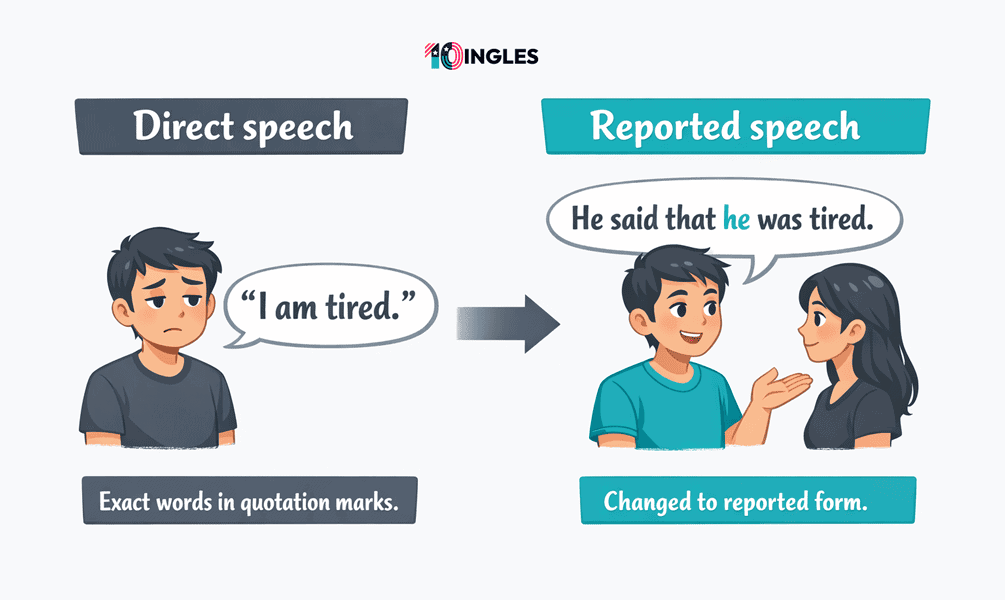
El discurso indirecto en inglés (o reported speech) es la estructura que usas para transmitir lo que otra persona dijo, sin citar sus palabras exactas, adaptando los tiempos verbales y pronombres.
Cuando quieres contar lo que alguien más dijo, escribió o pensó, el inglés te da dos opciones: el discurso directo o el indirecto.
El discurso directo (direct speech) es la transmisión de las palabras de alguien sin cambios. Reconocerlo al escribir es fácil: siempre va entre comillas.
- “Tom and I broke up because of his anime obsession,” Jenny said. — «Tomás y yo terminamos por su obsesión con el anime», dijo Jenny.
El discurso indirecto (reported speech, indirect speech) es la transmisión no exacta de la declaración de alguien, con tus propias palabras. Lo usas cuando no intentas citar palabra por palabra; lo más importante es el sentido general de lo dicho. En este proceso, la declaración original experimenta cambios gramaticales. Con esta explicación del reported speech, verás que es más fácil de lo que parece.
- Jenny said that she and Tom had broken up because of his anime obsession. — Jenny dijo que ella y Tomás habían terminado por su obsesión con el anime.
El sentido es el mismo, pero algunas palabras cambiaron: el pronombre I se convirtió en she, ya que no es la propia Jenny quien habla de sí misma en primera persona, sino que hablas sobre ella en tercera persona. También cambió el tiempo del verbo —de Past Simple a Past Perfect— y apareció la conjunción that. Más adelante te explico todo esto con detalle.
Mediante el discurso directo e indirecto en inglés puedes transmitir no solo lo que se dijo en voz alta, sino también un texto escrito o pensamientos:
- “I’ll be back by 5 p.m.,” Rob texted me. — «Regresaré a las 5 de la tarde», me escribió Rob por texto.
- Rob texted that he’d be back by 5 p.m. — Rob escribió que regresaría a las 5 de la tarde.
- “Keith is actually quite handsome,” Jenny thought. — «Keith es en realidad bastante guapo», pensó Jenny.
- Jenny thought that Keith was actually quite handsome. — Jenny pensó que Keith era en realidad bastante guapo.
Reporting clause y reported clause: las dos partes de la oración
Las oraciones con discurso directo e indirecto constan de dos partes:
Reporting clause son las palabras del autor. En esta parte de la oración informas que alguien dijo, escribió, pensó algo, etc.
Reported clause es la declaración original, el texto o el pensamiento que quieres transmitir.
| Reporting clause | Reported clause |
| Jenny thought, | “Keith is actually quite handsome.” |
| Jenny thought | that Keith was actually quite handsome. |
Reglas del reported speech: concordancia de tiempos
Por lo general, entre el momento en que se pronunció la frase original y el momento en que la repites ya ha pasado cierto tiempo. A nivel gramatical, esto se refleja en el cambio del tiempo verbal. La regla se puede resumir así:
- Los tiempos presentes (Present) pasan a pasados (Past).
- Los tiempos simples (Simple) pasan a perfectos (Perfect).
- El tiempo futuro (Future) pasa a futuro en el pasado (Future in the Past).
- El tiempo Past Perfect no cambia.

En las clases de inglés, los profesores solemos explicar que todos los tiempos deben dar “un paso atrás”. Dado que el hablante ya dijo, preguntó o explicó todo, informas esto en pasado (he said, she explained, etc.). En consecuencia, todo lo que dijo también pertenece al pasado y usas los Past tenses.
La siguiente tabla muestra todas las reglas de concordancia:
| Tiempos verbales | Ejemplo de discurso directo | Ejemplo de discurso indirecto |
| Present Simple → Past Simple | “I am a lawyer,” the guy in the suit said. | The guy in the suit said that he was a lawyer. |
| Present Continuous → Past Continuous | “I’m working on a new project,” Maggie explained. | Maggie said she was working on a new project. |
| Present Perfect → Past Perfect | “We have finished our drinks already,” the girls said. | The girls said they had finished their drinks already. |
| Present Perfect Continuous → Past Perfect Continuous | “I have been watching you for the last few hours,” said a strange lady. | A strange lady said that she had been watching me for the last few hours. |
| Past Simple → Past Perfect | “I got a promotion,” said Millie. | Millie said she had got a promotion. (o también Millie said she got a promotion si el contexto lo deja claro) |
| Past Continuous → Past Perfect Continuous | “I was waiting for three hours,” Jack complained. | Jack complained that he had been waiting for three hours. |
| Future (will) → Future in the Past (would) | “We will be home by 5 p.m.,” my friends promised. | My friends promised that we would be home by 5 p.m. |
| Past Perfect → Past Perfect (sin cambio) | “I had done everything by myself until we hired you,” my boss said. | My boss said that he had done everything by himself until they hired me. |
A continuación, te muestro cómo funciona el reported speech con ejemplos de comunicación para que veas el patrón en acción:
| Transición | Estilo directo | Estilo indirecto |
| Present Simple → Past Simple | Emma said, “I seldom chat with friends online.” | Emma said (that) she seldom chatted with friends online. |
| Present Continuous → Past Continuous | Emma said, “I am chatting with my friends now.” | Emma said (that) she was chatting with her friends. |
| Present Perfect → Past Perfect | Emma said, “I have just sent a text message to my friends.” | Emma said (that) she had just sent a text message to her friends. |
| Present Perfect Continuous → Past Perfect Continuous | Emma said, “We have been chatting for two hours.” | Emma said (that) they had been chatting for two hours. |
| Past Simple → Past Perfect | Emma said, “I sent a letter to my American friend last night.” | Emma said (that) she had sent a letter to her American friend the previous night. (o también Emma said (that) she sent a letter to her American friend the previous night si el marcador temporal es claro) |
| Past Continuous → Past Perfect Continuous | Emma said, “I was writing a letter at 5 p.m.” | Emma said (that) she had been writing a letter at 5 p.m. |
| Past Perfect → Past Perfect (sin cambio) | Emma said, “I had sent a couple of text messages to my friends by 6 o’clock.” | Emma said (that) she had sent a couple of text messages to her friends by 6 o’clock. |
| Will → would (futuro simple) | Emma said, “We will continue chatting tomorrow.” | Emma said (that) they would continue chatting the next day. |
| Will → would (futuro continuo) | Emma said, “We will be chatting at 5 p.m.” | Emma said (that) they would be chatting at 5 p.m. |
| Will → would (futuro perfecto) | Emma said, “I will have written three letters by 5 p.m.” | Emma said (that) she would have written three letters by 5 p.m. |
| Will → would (futuro perfecto continuo) | Emma said, “We will have been chatting for two hours by 5 p.m.” | Emma said (that) they would have been chatting for two hours by 5 p.m. |
Para profundizar en los cambios de tiempo, puedes revisar mi guía de marcadores de tiempos verbales en inglés.
Excepciones a la concordancia de tiempos
No siempre es necesario cambiar el tiempo del verbo. Hay varios casos donde se permite mantenerlo:
1. Si lo que pronunció el hablante sigue siendo cierto al momento de transmitir sus palabras.
Lana told me that they run a business together with her husband. — Lana me dijo que ellos tienen un negocio junto con su esposo. (Esta afirmación sigue siendo cierta).
2. Si lo que pronunció el hablante sucederá en el futuro para nosotros.
The Bakers said they’re expecting a baby in January. — Los Baker dijeron que esperan un bebé en enero. (Al momento de transmitir sus palabras, enero aún no ha llegado).
3. Hechos universalmente conocidos.
No hay necesidad de cambiar el tiempo cuando se trata de un hecho que siempre es verdad:
Mark said, “Tokyo is bigger than Moscow.” → Mark said that Tokyo is/was bigger than Moscow. — Mark dijo que Tokio es/era más grande que Moscú.
They said, “Time is money.” → They said that time is money. — Dicen que el tiempo es dinero.
4. El Past Simple no cambia cuando aparece después de conjunciones temporales como when, as, while, before, after, since, etc. (el verbo en la subordinada temporal suele mantener su forma).
She said, “I have been watching a movie since I got home.” → She said that she had been watching a movie since she got home. — Ella dijo que había estado viendo una película desde que llegó a casa.
5. Al transformar oraciones con modo subjuntivo, la forma del verbo generalmente permanece inalterada.
She should be discharged if she were seen going out with her student.
He said that she should be discharged if she were seen going out with her student. — Él dijo que ella debería ser despedida si alguien la viera saliendo con su alumno.
6. Si el verbo en la parte principal está en presente (says, tells), el tiempo en la parte subordinada generalmente no cambia:
She says, “I am working on a new project.” → She says that she is working on a new project.
7. Citas famosas, refranes y expresiones fijas también mantienen el tiempo:
Michael on the phone: “I’ll be home in 15 minutes.” → Michael said he will be home in 15 minutes.
Verbos modales en el reported speech
Al pasar el discurso directo al indirecto, los verbos modales también cambian, pero no todos. Aquí el resumen completo:
| Verbos modales | Ejemplo de discurso directo | Ejemplo de discurso indirecto |
| can → could | “You can call me later,” she said. | She said that I could call her later. |
| may → might (posibilidad) | “I may need this laptop,” my brother said. | My brother said he might need that laptop. |
| may → could (permiso) | “You may sit,” the principal said. | The principal said that we could sit. |
| must → had to (obligación en el pasado) | “You must report any suspicious activity,” the boss said. | The boss said that we had to report any suspicious activity. |
| must (deducción/suposición) — no cambia | “It must be cold in Siberia,” Sharon said. | Sharon said it must be cold in Siberia. |
| must (consejo u orden fuerte) — puede mantenerse o usar had to | “You must be more attentive,” the teacher said. | The teacher told him he must be more attentive. (o he had to be more attentive) |
| could — no cambia | “You could borrow my coat,” my sister said. | My sister said I could borrow her coat. |
| should — no cambia | “You shouldn’t waste any more time,” my parents told me. | My parents told me that I shouldn’t waste any more time. |
| would — no cambia | “I would give you anything you wanted,” he said. | He said he would give me anything I wanted. |
| might — no cambia | “I might change my mind again,” she warned me. | She warned me that she might change her mind again. |
| need — no cambia | “You needn’t bring your stuff with you,” the manager said. | The manager said we needn’t bring our stuff with us. |
| used to — no cambia | “We used to go to the mall every day,” John said. | John said they used to go to the mall every day. |
| ought to — no cambia | “We ought to be at the train station by 5 p.m.,” the guide said. | The guide said we ought to be at the train station by 5 p.m. |
En resumen: might, could, would, should y ought to permanecen inalterados en el estilo indirecto. El verbo must tiene dos comportamientos principales según el contexto: va a had to cuando expresa obligación pasada, y puede mantenerse cuando expresa deducción o una orden fuerte. Los verbos can y may sí cambian.
Puedes profundizar en cada uno de estos verbos en mis guías: can y could y might y may.
Cambios de pronombres y adverbios de tiempo
Al dar el paso al pasado, también debes cambiar las palabras que se refieren al presente o al futuro. Si hablas de algo que ya pasó, ya no sirven palabras como “aquí”, “ahora” o “mañana”; es necesario reemplazarlas por sus equivalentes en pasado.

La tabla con los casos más comunes:
| Adverbio/pronombre | Cambio | Ejemplo en discurso directo | Ejemplo en discurso indirecto |
|---|---|---|---|
| this | → that | “What’s the name of this song?” Mary asked. | Mary asked what the name of that song was. |
| these | → those | “Can I borrow these shoes?” my sister asked. | My sister asked if she could borrow those shoes. |
| here | → there | “I’ll be here when you need me,” he promised. | He promised he’d be there when I needed him. |
| now | → then / at that moment | “Do you have any seats available now?” we asked. | We asked if they had any available seats at that moment. |
| today | → that day | “I saw him today,” she said. | She said she had seen him that day. |
| yesterday | → the day before | “I did my homework yesterday,” my daughter said. | My daughter said she’d done her homework the day before. |
| tomorrow | → the next day | “I’ll pick you up tomorrow,” Dad promised. | Dad promised to pick me up the next day. |
| ago | → before | “School started two days ago,” Johnny said. | Johnny said that school had started two days before. |
| last week | → the previous week | “I called last week,” he said. | He said he had called the previous week. |
| next month | → the following month | “We leave next month,” they said. | They said they were leaving the following month. |
Tipos de oraciones en el discurso indirecto
Oraciones afirmativas
Cuando transmites oraciones afirmativas en discurso indirecto, la reported clause puede contener la conjunción that. En la práctica, a menudo se omite, especialmente en el habla cotidiana.
| Discurso directo | Discurso indirecto |
| Peter said, “I’ll be heading home after lunch.” | Peter said (that) he’d be heading home after lunch. |
| Mum told me, “You can borrow my phone.” | Mum told me (that) I could borrow her phone. |
Preguntas en el reported speech (reported questions)
Las preguntas indirectas se diferencian de las normales en que utilizan el orden directo de las palabras, es decir, sin verbos auxiliares ni inversiones.
Las preguntas generales (yes/no questions) y las preguntas alternativas, al entrar en el discurso indirecto, se acompañan de if o whether. No hay diferencias estilísticas entre ambas, aunque if es más frecuente en el habla cotidiana y whether se prefiere en contextos más formales o cuando hay una elección entre opciones.
| . | Discurso directo | Discurso indirecto |
| Pregunta general | “Would you like some tea?” Nana asked. | Nana asked if/whether we would like some tea. |
| Pregunta alternativa | “Do you want biscuits or sweets with your tea?” Nana asked. | Nana asked if/whether we wanted biscuits or sweets with tea. |
Más ejemplos:
- “Do you speak English?” she asked me. → She asked me if I spoke English. — Ella me preguntó si hablo inglés.
- I asked my friend, “Have you finished reading my book?” → I asked my friend if she had finished reading my book. — Le pregunté a mi amiga si había terminado de leer mi libro.
Las preguntas especiales (wh-questions) conservan la palabra interrogativa pero cambian el orden de las palabras de invertido a directo. Si usas un verbo auxiliar, debes eliminarlo.
| Discurso directo | Discurso indirecto |
|---|---|
| “What do you want for dinner?” Dad asked. | Dad asked me what I wanted for dinner. |
| “When did you arrive in Bangkok?” asked the lady. | The lady asked us when we had arrived in Bangkok. |
| “What are you doing?” he asked me. | He asked me what I was doing. |
| “Why did you miss the lesson?” she asked him. | She asked him why he missed the lesson. |
| He asked me, “Where do you live?” | He asked me where I lived. |
*El verbo to ask puede sustituirse por sinónimos: to question, to inquire, to enquire, to demand.
Oraciones imperativas: órdenes, peticiones y consejos
Si la oración contiene una orden, exhortación, consejo o petición, en el discurso indirecto comenzamos la oración con un infinitivo con la partícula to. En oraciones negativas, la partícula not se coloca antes del infinitivo.
Fórmula: Reporting Verb + complemento + (not) + to + infinitivo
| Discurso directo | Discurso indirecto |
| “Stay here and wait,” the man ordered. | The man ordered us to stay there and wait. |
| “Don’t get stuck in the past,” Brian advised. | Brian advised me not to get stuck in the past. |
| “Be quiet!” the teacher told the pupils. | The teacher told the pupils to be quiet. |
| “Don’t forget about it, please” she asked me. | She asked me not to forget about it. |
Para transmitir estas construcciones se usan reporting verbs que expresan orden o petición: to tell, to order, to ask, to urge, to beg, to command, to warn, to instruct.
Más ejemplos con reporting verbs específicos:
- My mom said to me, “Switch on the light.” → My mom told me to switch on the light.
- The father said to his daughter, “Do take care of your little brother.” → The father urged his daughter to take care of her little brother.
- She said to me, “Don’t open the door.” → She told me not to open the door.
- The child said to his mom, “Don’t take me to the museum!” → The child begged his mom not to take him to the museum.
Para revisar en detalle el funcionamiento del modo imperativo en inglés, he preparado una guía completa.
Exclamaciones, propuestas, disculpas y agradecimientos
Cuando conviertes exclamaciones al estilo indirecto, no es el verbo sino los complementos circunstanciales de modo los que muestran el carácter del enunciado: alegría, sorpresa, tristeza, etc.
| Estilo directo | Estilo indirecto |
| Tom said, “How pleasant! Sarah is going to join us!” | Tom cried joyfully that Sarah was going to join them. |
| Kelly said, “I’m so sorry, but Mary is leaving us!” | Kelly said sadly that Mary was leaving them. |
| He said, “I’m sure that we’ll never have such fun again!” | He said regretfully he was sure that they would never have such fun again. |
| Molly said, “I’m sure you’ll forget me as soon as you leave!” | Molly said with bitterness that she was sure he would forget her as soon as he left. |
| He said to me, “You are lying to me!” | He cried indignantly that I was lying to him. |
| Donna said to him, “Have you really read all these novels?!” | Donna asked him in surprise if he had really read all those novels. |
| Mike said to her, “Please, forgive me for having lied to you!” | Mike begged her forgiveness for having lied to her. |
El estilo directo se considera más emocional que el indirecto. Al hacer el cambio, a veces es necesario añadir conjunciones para expresar relaciones causales:
- Mike said, “I’m sick and tired! I’ve been working for them for ten years!” → Mike said (that) he was sick and tired as he had been working for them for ten years.
Si algunas frases o palabras se repiten en el estilo directo, a menudo se omiten en el indirecto:
- Sarah said, “It’s so sweet of you to give me this present, so sweet of you indeed!” → Sarah said that it was so sweet of me to give her that present.
Es mejor sustituir las interjecciones por los complementos circunstanciales correspondientes:
- Donna said, “Alas! I’ll never see him again!” → Donna exclaimed in despair that she would never see him again.
Propuestas: se transmiten con to offer y to suggest.
- The man said to her, “Shall I bring you a glass of water?” → The man offered to bring her a glass of water.
- She said to him, “What about going there together?” → She suggested that they should go there together.
Consejos: se transmiten con to advise.
- Bella said to him, “You’d better take a cab or you may be late for the meeting.” → Bella advised him to take a cab, as otherwise he might be late for the meeting.
Disculpas: se transmiten con to apologize y to beg one’s pardon.
- She said to the teacher, “I’m sorry for being late.” → She apologized to the teacher for being late.
- Mary said to him, “Beg your pardon, I’ve left your encyclopedia at home.” → Mary begged his pardon for having left his encyclopedia at home.
Agradecimientos: se transmiten con to thank y to express one’s gratitude.
- Tom said to them, “Thank you for helping me out!” → Tom thanked them for helping him out.
- Elon said to me, “Thank you for coming!” → Elon expressed his gratitude to me for coming.
Reporting verbs: más allá de say y tell
Para transmitir el discurso oral de alguien, lo más frecuente es usar to say y to tell. La diferencia clave:
To say no requiere indicar a quién se dirigieron las palabras. Es más universal y se usa con más frecuencia.
- She said she had to do some more work.
Si quieres indicar a quién se dirigió el discurso, usas la preposición to:
- She said to me that she had to do some more work.
To tell necesariamente se acompaña de la persona a la que se dirigieron las palabras, y sin preposición:
- She told me she had some more work to do.
La elección del verbo puede cambiar el matiz del enunciado. Aquí algunos ejemplos:
| Estilo directo | Estilo indirecto |
| Donna said to me, “I hope you haven’t forgotten that there will be a conference.” | Donna reminded me that there would be a conference. |
| She said, “Chinese is difficult to learn.” | She remarked that Chinese was difficult to learn. |
| My father said, “I did tell her the truth.” | My father admitted that he had told her the truth. |
| My colleague said, “I’ve never taken your folder.” | My colleague denied that he had taken my folder. |
| Billy said to her, “I will certainly join you at the party.” | Billy assured her that he would join her at the party. |
| Matt said, “I’ve never seen this movie before.” | Matt declared (that) he had never seen that movie before. |
| Matt said, “I never expected she would do such a terrible thing!” | Matt exclaimed he had never expected she would do such a terrible thing. |
| They said, “We are getting married!” | They announced that they were getting married. |
| My boss said to me, “You will have to go on a business trip.” | My boss informed me that I would have to go on a business trip. |
La siguiente tabla reúne los verbos más usados en reported speech:
| Verbo | Traducción | Verbo | Traducción |
| to say | decir | to suggest | sugerir, proponer |
| to tell | decir, contar | to interrupt | interrumpir |
| to add | añadir | to offer | ofrecer |
| to admit | admitir | to yell | gritar |
| to advise | aconsejar | to reply | responder |
| to agree | acordar | to continue | continuar |
| to announce | anunciar | to confirm | confirmar |
| to answer | responder | to hint | insinuar |
| to ask | preguntar | to insist | insistir |
| to claim | afirmar | to enquire | preguntar, indagar |
| to comment | comentar | to encourage | alentar, animar |
| to complain | quejarse | to persuade | persuadir |
| to confess | confesar | to confirm | confirmar |
| to cry | gritar | to demand | exigir |
| to explain | explicar | to inform | informar |
| to maintain | sostener | to note | notar, señalar |
| to observe | observar | to order | ordenar |
| to point out | señalar | to promise | prometer |
| to state | declarar | to threaten | amenazar |
| to warn | advertir | to wonder | preguntarse |
| to protest | protestar | to repeat | repetir |
| to shout | gritar | to remark | observar, notar |
El Present Simple en la reporting clause aparece en tres casos:
- La afirmación sigue siendo cierta al momento en que la repites.
Ann says she’s teaching foreign students. — Ann dice que se dedica a la enseñanza de estudiantes extranjeros. - La persona repite a menudo la frase que se transmite en la reported clause.
My parents say I should concentrate on my studies. — Mis padres dicen que debo concentrarme en mis estudios. - Esta construcción es característica de los titulares de noticias.
Police claim there will be more victims. — La policía afirma que habrá más víctimas.
El Past Continuous en la reporting clause se usa en el diálogo cuando quieres transmitir información que acabas de escuchar:
- Your wife was telling me you’ve been promoted to CMO. Congratulations! — Tu esposa me estaba diciendo que te han ascendido a director de marketing. ¡Felicidades!
- What a coincidence! Jackie was just saying that she wants to go to Thailand too. — ¡Qué coincidencia! Jackie justo estaba diciendo que ella también quiere ir a Tailandia.
Reported speech en inglés: resumen
- Estilo directo → Estilo indirecto: se quitan las comillas; los pronombres, indicadores de tiempo y formas verbales a menudo cambian.
- Concordancia de tiempos: al pasar al estilo indirecto, el tiempo se desplaza hacia atrás (Present → Past → Past Perfect), pero se mantiene para hechos universales, citas, acciones actuales y algunos verbos modales.
- Indicadores de tiempo: now → then, today → that day, tomorrow → the next day, yesterday → the day before, etc.
- Reporting verbs: utiliza diferentes verbos para transmitir el sentido exacto (to say, to tell, to ask, to admit, to explain, to advise, to warn, to remind, to announce, etc.).
- Preguntas generales: se añaden if/whether con el significado de «si».
- Preguntas especiales (wh-questions): conservan la palabra interrogativa y el orden directo de las palabras.
- Modo imperativo: las órdenes y peticiones se transmiten a través del infinitivo: “Don’t touch it!” → She told me not to touch it.
- Verbos modales: must, should, could, would, might a menudo no cambian.
- Emociones y exclamaciones: se transmiten a través de adverbios y verbos descriptivos (exclaimed, cried joyfully, said sadly).
- Órdenes, consejos, propuestas, disculpas, agradecimientos: se transmiten con reporting verbs especiales: to advise, to suggest, to apologize, to thank, to offer.
Test de reported speech (10 preguntas)
Comprueba cuánto retuviste. Elige la opción correcta en cada caso:
1. Kate said, “Don’t touch my laptop!”
- a) She said don’t touch her laptop.
- b) She said not to touch her laptop.
- c) She said didn’t touch her laptop.
2. Dexter asked, “How many museums have you visited in your life?”
- a) Dexter asked how many museums had you visited in your life.
- b) Dexter asked how many museums we have visited in our life.
- c) Dexter asked how many museums we had visited in our life.
3. Donna said, “Let’s go to the park.”
- a) Donna suggested let’s go to the park.
- b) Donna suggested going to the park.
- c) Donna suggested go to the park.
4. She said, “My life is full of kind people.”
- a) She said that my life was full of kind people.
- b) She said that her life was full of kind people.
- c) She said that her life had been full of kind people.
5. Bobby said, “My best friend can play the piano.”
- a) Bobby said that his friend had been able to play the piano.
- b) Bobby said that my friend can play the piano.
- c) Bobby said that his friend could play the piano.
6. Michael said, “Do you know this woman in red?”
- a) Michael asked if I knew that woman in red.
- b) Michael asked if had known that woman in red.
- c) Michael asked do I know that woman in red.
7. Ben said, “How nice! She is going to spend the weekend with us!”
- a) Ben cried that he was going to spend the weekend with them.
- b) Ben said that she was going to spend the weekend with us.
- c) Ben cried joyfully that she was going to spend the weekend with them.
8. My boss said to everyone, “You should arrange a birthday party for Mr Green.”
- a) My boss said to everyone that we had to arrange a birthday party for Mr Green.
- b) My boss informed everyone that we should arrange a birthday party for Mr Green.
- c) My boss said to everyone that you should arrange a birthday party for Mr Green.
9. Mary said, “I must meet my parents at four o’clock.”
- a) Mary said that she had to meet her parents at four o’clock.
- b) Mary said that she was to meet my parents at four o’clock.
- c) Mary said that she must to meet her parents at four o’clock.
10. Laura said, “I’m going to visit you tomorrow.”
- a) Laura said she was going to visit me tomorrow.
- b) Laura said she was going to visit her the next day.
- c) Laura said she was going to visit me the next day.
Respuestas Correctas
Preguntas frecuentes
¿Cuándo se usa el discurso indirecto en el idioma inglés?
Usas el discurso indirecto cuando quieres transmitir el sentido de lo dicho, sin tener como objetivo mantener la formulación exacta. Con la ayuda del discurso indirecto se puede transmitir no solo lo que se dijo en voz alta, sino también el discurso escrito o los pensamientos.
¿Cómo se forma el discurso indirecto en el idioma inglés?
Para convertir el discurso directo en indirecto es necesario:
- Cambiar el tiempo del verbo léxico o el verbo modal en la reported clause.
- Cambiar los pronombres personales si estás citando las palabras de otro y no las tuyas.
- Cambiar los pronombres demostrativos y los marcadores de tiempo si están en la oración.
- Si la oración citada es afirmativa, añadir la conjunción that (opcional).
- Si la oración citada es interrogativa, cambiar el orden de las palabras de invertido a habitual. En el caso de las preguntas generales y alternativas, añadir if o whether.
- Si la oración citada es imperativa, cambiar el imperativo por infinitivo con la partícula to.
¿Cuándo se usa if en el estilo indirecto y cuándo whether?
Ambas palabras se traducen como «si» y se aplican al transmitir preguntas generales (Yes/No). If se utiliza con mayor frecuencia en el lenguaje hablado y escrito. Whether se aplica en un estilo más formal y en casos donde hay una elección entre opciones:
- She asked, “Do you like coffee?” → She asked if I liked coffee.
- I asked him, “Are you coming or staying?” → I asked him whether he was coming or staying.
¿Es necesario cambiar siempre el tiempo al pasar del estilo directo al indirecto?
No, el tiempo no siempre cambia. Si se trata de un hecho universal o una verdad, el tiempo puede dejarse sin cambios. Si la acción o el estado siguen siendo actuales en el momento en que se dice el estilo indirecto, el tiempo también puede no cambiarse. Los verbos modales que no tienen forma de pasado (should, would, could, might) generalmente permanecen sin cambios.
La habilidad para transmitir el discurso directo mediante el indirecto se adquiere con la práctica. Puedes, por ejemplo, relatar episodios de películas o contar en inglés tus conversaciones con amigos. Mientras practicas, no olvides usar sinónimos de say y ask para que tu relato no sea monótono.
¿Quieres seguir practicando? El British Council tiene una introducción al reported speech en español: Reported Speech en inglés — British Council España
Comentarios